
Change the weights.
Keep the proof.
A complete Aner application acquires the model, replays the published MIT edit to a real Qwen checkpoint, verifies what changed, and restores the original bytes. Explicit weight programs create a candidate; measured evaluation decides whether it helps.
100% Aner application code · Direct weight replacement · Reversible artifacts
Program the change.
Then test the behavior.
Ordinary training computes updates from a loss and its gradients. Weight space programming explores gradient free adaptation: a reasoning model or a person specifies changes directly. Both alter a model’s parameters; they differ in how the update is produced.
Examples → loss → optimizer
The training objective guides many numerical updates. This remains the established path for learning from data at scale.
Inspection → proposal → checked edit
A declarative patch identifies exact positions and replacement values. Aner validates and records the transaction; an evaluation determines whether it helped.
The MIT study shows that direct changes can repair particular failures, including excessive reasoning loops. Its negative results also matter. An exact patch replay demonstrates engineering fidelity; it does not establish that arbitrary new skills can be written into arbitrary models.
130,188 changed values.
Every one accounted for.
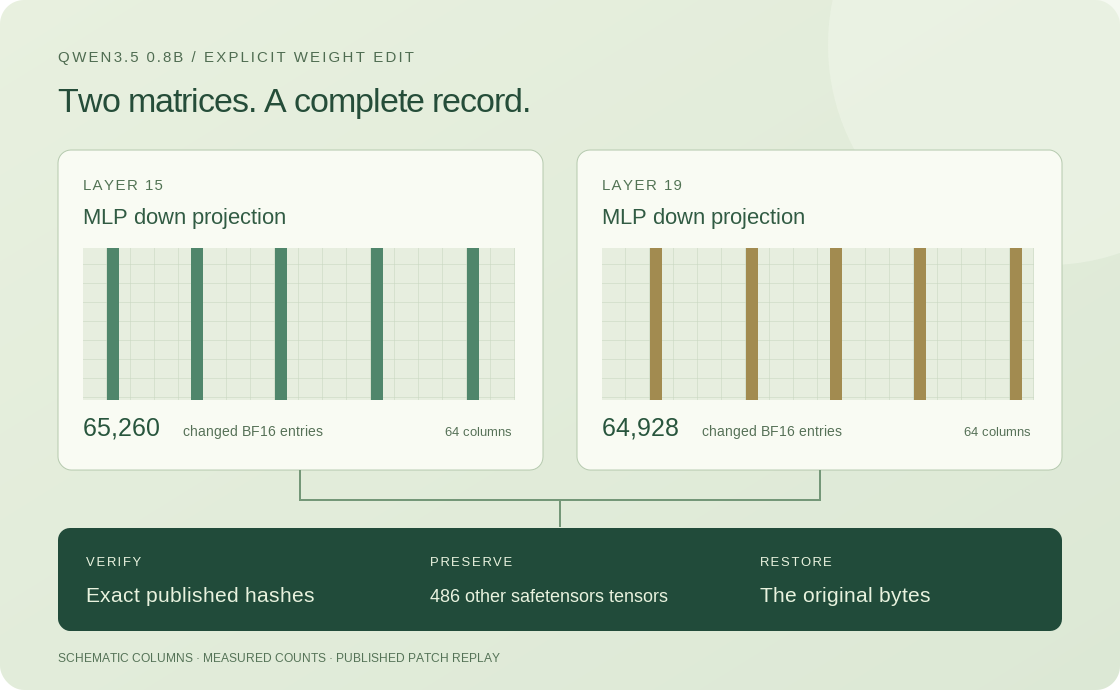
The released MIT patch changes selected columns of two Qwen3.5 0.8B MLP down projection matrices. Aner replays the stored BF16 bit patterns directly in both safetensors and GGUF, with no conversion or approximation.
A small edit. A verifiable path back.
- 01 PIN THE ORIGINAL
Original weights
A known checkpoint, before any edit.
File identity verified04b1c301…f1fe4696 - 02 BOUND THE CHANGE
Two layers edited
130,188 stored BF16 replacements.
Layer 15 65,260 changesLayer 19 64,928 changes64 selected columns in each matrix.
Surrounding weights stay unchanged. - 03 VERIFY AND EVALUATE
Edited model
A separate candidate, ready for inference.
Target tensor hashesMatch the MIT referenceThe original file remains intact.
Accuracy is measured separately. - 04 APPLY THE INVERSE
Exact restoration
The original bytes, in a new destination.
Original file hash restored04b1c301…f1fe4696
Acquire → inspect → edit → evaluate → restore.
One application, written entirely in Aner.
1 / 8 correct → 1 / 8 correct.
Exact weight changes; no demonstrated accuracy gain.
| Tensor | Shape | Selected columns | Stored changes | Verification |
|---|---|---|---|---|
| Layer 15 · down projection | 1,024 × 3,584 | 64 | 65,260 | Exact reference match |
| Layer 19 · down projection | 1,024 × 3,584 | 64 | 64,928 | Exact reference match |
The original intervention targeted 131,072 positions. BF16 rounding left some positions unchanged, so the released sparse archive stores only 130,188 replacements. Aner reports the stored changes separately from the original intervention size.
The original safetensors checkpoint contains 488 tensors; its other 486 tensors are unchanged. The official GGUF export contains 335 tensors; its other 333 tensors are unchanged. Both edited matrices have the same verified bytes across formats. Each reversal restores its own complete original file hash.
Inspect the recorded checkpoint identities
Original safetensors file SHA25604b1c301231dd422b8860db31311ab2721511346a32cb1e079c4c4e5f1fe4696
Edited safetensors file SHA256bd5c223dc7d0ed48a6857f798a94da6ec46c40b9ff4e7bc31872dba10f943ae5
Original GGUF file SHA2569a7bed4041b7975e0f71fa34670d1e9025213bc92905ac0db75d36c4fa3fa623
Edited GGUF file SHA256f67c865e3961f13e03ac002de1b797d6806e3f80f5443926ab07a8cf1e023597
Layer 15
Beforeef60d2c687bab19464dca9c8bfd7777e46ad226df0c9e25643b0bab04b5a1cca
After82e2d733ea64feaeb4af93a1e065641d3df98b494a8b7576ef2f52e90fe2ee53
Layer 19
Before638eedeb701b94aa861f4438e615c07ec6c60ee703db1bfee2de577bb6498c3e
After8ef3c61bc36af113ad58e89dbb0a4a14dcba5a45cb750c15ab515c82ddd12eb2
Both reversals match their original complete file SHA256. These digests identify bytes. They do not certify authorship, usefulness or model quality.
Make the candidate new.
Keep the original intact.
The application is written entirely in Aner and calls its native model APIs directly. A patch is data: named tensors, explicit positions, replacement bits and declared numerical limits.
llm.fetch_artifact downloads or verifies artifacts against a pinned SHA256 and byte count. llm.weight_import_npz imports the released sparse archive into a checked patch for each checkpoint format. Acquisition and binary parsing are bounded native operations; the application remains Aner source.
- 01
Inspect
llm.weight_inspectIdentify the complete checkpoint and each tensor by shape, datatype and cryptographic digest.
- 02
Check
llm.weight_checkValidate the declared scope, indices, replacement bits and numerical change limits before writing.
- 03
Apply
llm.weight_applyPublish a new checkpoint, the admitted patch, an inverse and a receipt. Preserve the original.
- 04
Restore
llm.weight_revertVerify the transaction and restore the exact original bytes into another new destination.
The application passed 11 helper checks. Its replay and reversal programs separately executed against both complete Qwen files and asserted the expected hashes. The pilot programs recorded the original and edited responses, token counts and evaluation summaries.
Language and helper checks validate application contracts; the separate execution receipts establish that the real checkpoints changed and were restored. Review the application checks on GitHub.
A patch author declares its scope. The supervising application must independently decide which tensors and limits are permitted. The engine verifies the declared transaction; it is not an independent permission policy or an automated edit proposer.
The edit replays exactly.
Behavior still needs evidence.
The Aner application configures llm.with_sampling and calls llm.complete with explicitly rendered Qwen prompts. Prompt construction, answer grading and aggregation are all Aner code. It records responses and native timing data for each condition.
Both evaluation budgets completed in Aner.
The short pilot and longer controls below were executed by the complete Aner application. Prompt construction, sampling configuration, grading and summaries remain explicit in the application. Neither run is a full benchmark replication. The measurement record identifies the exact runtime build.
The Aner pilot shows no demonstrated gain.
Correct final answers
Correct final answers
No demonstrated gain in this small pilot.
7 of 8 generations reached the token ceiling in each condition. There was 1 rescue and 1 regression.
Eight selected prompts, one generation per model and prompt, executed by the Aner application through llm.complete. The 2,048 token ceiling and native backend differ from the authors’ full benchmark protocol. Thinking enabled; temperature 0.6, top p 0.95, top k 20 and presence penalty 1.5. The authors used a 32,768 token ceiling for their reported benchmark results. Eight prompts with one sample each cannot establish broad model quality or a reliable improvement.
Correctness uses the application’s limited boxed-integer grader: it extracts a final integer answer and compares it with the expected result. This is not a general mathematical equivalence test.
The original model generated 15,458 tokens in total and the edited model generated 16,005. This bounded pilot demonstrates execution, not a general accuracy or efficiency improvement.
A longer budget did not establish a gain.
With a 32,768 token ceiling, both models answered 2 of 2 selected control prompts correctly, with no truncation. The original generated 4,480 tokens in total; the edited model generated 13,066. One edited answer used 334 fewer tokens and the other used 8,920 more.
These repeat two prompts from the short pilot with a longer ceiling. Two selected controls are not an independent held out benchmark and cannot measure general accuracy or efficiency. The changed model executes correctly; these observations do not establish a quality or efficiency improvement.
Demonstrated here
Exact published patch replay, unchanged source and other tensors, exact reversal, and measured inference execution.
Still separate research
A comparable full benchmark replication and discovery of a new edit. Neither is claimed by this case.
A focused addition to
the numerical workflow.
The transaction engine builds on Aner’s existing native approach to explicit parameters and reproducible computation. It adds checkpoint control without changing the meaning of inference or training.
aner.tensor
Represent numerical values and compose explicit operations. The checkpoint editor preserves raw encoded weights rather than widening them into another datatype.
aner.nn
Build small networks with explicit weights and native inference. Direct programming can be evaluated alongside gradient based learning.
aner.gen
Inspect and replace parameters in its supported generative models. That explicit parameter model is related to this experiment; Qwen execution here belongs to aner.llm.
aner.llm
Acquire pinned artifacts, import the released patch, edit and restore checkpoints, configure sampling and complete explicit prompts. Aner programs own the whole experiment.
aner.api
Serve supported loaded models when an application needs an API. This local experiment calls aner.llm directly and does not require a server.
Requires Aner v0.0.8 or later with these APIs: llm.fetch_artifact, llm.weight_import_npz, llm.weight_inspect, llm.weight_check, llm.weight_apply, llm.weight_revert, llm.load, llm.with_sampling, llm.complete. A runtime must also provide the native Qwen3.5 backend used by the experiment. Verify the programs with aner check before running them; version numbering alone does not verify backend availability.
The application loads the pinned Qwen3.5 BF16 GGUF through llm.load and uses the explicit raw completion path; it owns the model-specific prompt format. Every application program is an .aner file. The website does not execute a model or store its weights.
The complete record
belongs with the source.
The published GitHub repository keeps the complete Aner application, tests, raw outputs and reproducibility instructions together.
Model weights are obtained separately from their original publishers. This page presents the case; it offers no application source or evidence downloads.
Check the runtime and programs.
Use the repository project with a compatible Aner runtime. Run
aner checkon its five programs, then runprograms/check-helpers.aner. The repository guide contains the complete commands and expected outputs.Acquire the pinned model and replay.
programs/replay.aneracquires the original safetensors checkpoint, the official BF16 GGUF export and the published sparse patch. It verifies SHA256 and byte counts, reuses matching local files, imports the patch and writes separate edited checkpoints.Evaluate, then restore.
Run
programs/pilot-short.anerandprograms/pilot-long.anerto record the paired results. Runprograms/revert.anerto restore both original checkpoints into separate destinations and verify their complete hashes. Keep the receipts and observations with the experiment.
Recorded measurement build: Aner 0.0.8-dev.2. The checkpoint receipts and pilot evidence retain that exact identity. Public application code consists of Aner programs; runtime availability is listed separately on Downloads.
The MIT research
Sparks of Weight Space Programming, the authors’ research report. The Qwen intervention addresses reasoning loops; the report also retains unsuccessful experiments.
The released experiment
Pinned experiment logs, the sparse patch, reference semantics and evaluation protocol. Research data and logs retain their CC BY 4.0 attribution.
The original checkpoint
The exact Qwen source revision. Aner checks its complete file identity before applying the published patch.
The native inference export
The official BF16 GGUF export, edited and loaded directly through aner.llm. Both target matrices match the original checkpoint before the edit.