
Native parallel computing
Run reproducible native CPU tasks with explicit execution contexts, bounded allocations and approved process or SSH workers; inspect complexity and native Dense replica training.
ImplementedAner 0.1.0 or newerThe matching source build SDK also supports a narrower compiled typed task path. That path enrolls the matching compiled program as its worker and never uses the source/session interpreter protocol described by the installed runtime examples below. Keep the two execution and worker identities distinct; choosing a cluster context alone does not establish that its task was compiled.
aner.parallel separates a programmer's algorithm from its execution policy. The module schedules checked independent tasks, collects their ordered numeric outputs and reports execution resources. Algorithms, random distributions and model fitting belong to their own source programs or modules.
This guide targets Aner 0.0.4 or newer and matching editor help. aner check validates declarations without starting work. The source API does not automatically distribute arbitrary source code, shared mutable objects or Tensor graphs.
Development cluster setup uses aner parallel native enroll for fresh private records and aner parallel native preflight for admission only checks through an approved compiled program. These commands retain C++20, strict host key checks and ABI/protocol identities; preflight runs no source level statements, scientific parameters or task callbacks. See native enrollment/preflight. Linux and Windows execution tests remain deferred.
Tasks, workers and CPUs
A task is one checked invocation of a programmer defined function. A local worker is a reusable native thread that executes tasks from the bounded queue. parallel.local(workers: 4) requests four worker threads within the effective CPU budget. The operating system schedules those threads on eligible logical CPUs; workers can time share or migrate. Aner neither reserves a core nor pins a thread to a CPU.
| Term | Meaning |
|---|---|
| Task | One queued function invocation; a worker can execute many tasks |
| Local worker | A native executor thread |
| Logical CPU | An OS execution resource; several may share one physical core |
| Effective CPU budget | Admission limit derived from visible hardware, affinity, quotas and scheduler limits |
| Configured cluster worker | An explicitly enrolled local or SSH process; its slots bound admission rather than reserve CPU identities |
A request above the effective CPU budget fails. Fewer runnable tasks can leave workers idle. Local executor active_tasks and peak_active measure task state, including waiting for CPU time. Source cluster repetition labels global peak_active_scope as node-requests, counting simultaneous requests; per node peaks retain local task activity. None measures instantaneous CPU utilization. Measure complete elapsed time and use OS process measurements when evaluating scaling.
Start with one simple task
aner.random owns number generation. aner.parallel owns task execution:
import aner.parallel
import aner.random

fn pick_number(parameters: List, index: Int64, task_seed: Int64) -> Int64 {
    return random.integer(low: 1, high: 10, seed: 42, draw: index)
}

let results = parallel.repeat(iterations: 100_000, task: pick_number,
    parameters: List(), execution: parallel.local(workers: 1))
print(results.rows())
print(results.mean())
print(results.summary())
parameters: List() supplies no extra configuration. Aner supplies the zero based index and a derived task seed to every invocation. This task deliberately uses the fixed root seed and global index, so changing worker allocation preserves each generated value. Change workers: 1 to an admitted positive count, use parallel.local() for automatic allocation, or select an enrolled CPU group with parallel.cluster(config: "private.cluster"). The function stays the same; the initial cluster route has narrower input/dependency and transport limits documented below.
Each iteration owns its parameter copy and local state. Results are committed in iteration order, independently of completion order. Scalar outputs become a one column immutable SimulationResults object with native Float64 storage. Integers must be exactly representable. RandomGenerator mutable state is not shared across workers; use explicit seed/draw identities in tasks.
Module guide
| Work | API and guide | Source |
|---|---|---|
| Process independent images | parallel.repeat; CPU parallelism in practice | Compact image batch, sequential/parallel comparison; recorded image benchmark |
| Independent stochastic paths | Repetition API and results | Growth paths, scenarios |
| Spatial model uncertainty | Heat diffusion model and statistics | Realizations, measured benchmark |
| Parallelize one loop | Worked dice example | Balanced and weighted dice |
| Estimate π as an example algorithm | Ordinary Aner code with random.uniform and parallel.repeat | local serial/parallel program |
| Enroll two or more computers | Cluster setup guide | Native CPU counting example, configuration template |
| Inspect resources | parallel.inventory() | No remote configuration needed |
| Fit a Dense classifier | ml.fit with an execution context; distributed neural training | Local CPU training, configured Dense replicas |
| Query a fitted KNN classifier | KNN query methods with execution: parallel.local(...); native KNN query execution (development) | Uniform and distance weighted KNN queries |
The π program contains its own quarter circle algorithm and computes 4 × mean(hit); there is no public π specific method or result type in this module. It uses Philox and has sampling error. It is separate from the historical native CLI benchmark described below.
Native KNN queries (development)
KNN query methods in aner.ml can reuse a parallel.local(...) context through their execution argument. The native KNN kernel schedules independent query rows on that existing executor, sharing immutable fitted data and retaining private worker scratch. Existing calls remain serial and use uniform voting unless weights: "distance" was selected when fitting. Both additions require the matching unreleased runtime/editor; see KNN parameters, workspace, determinism and measured costs.
Call the KNN query method directly. Generic parallel.repeat tasks continue to reject ML calls, and GPU/neural-device or cluster contexts are not admitted for KNN. This native library integration does not add Tensor/model lowering to aner build.
API reference: execution policies
| Signature | Contract |
|---|---|
parallel.local() -> ParallelContext | Automatic local CPU worker allocation |
parallel.local(workers: Int64) -> ParallelContext | Explicit positive worker count; zero requests automatic allocation |
parallel.cluster(config: String) -> ParallelContext | Explicit enrolled worker descriptor; no network scanning |
parallel.inventory() -> String | JSON CPU limits, policy and discovery notes |
parallel.repeat(iterations: Int64, task: ParallelTask, parameters: List, ...) -> SimulationResults | Checked independent local or admitted cluster CPU tasks; optional execution, seed and result budget |
ParallelContext is immutable. Source level local and cluster do not expose a sample chunk argument. Grouping small scientific operations into one task is part of the programmer's algorithm. The cluster transport can batch several distinct task invocations into one bounded request without changing their global identities, private state or output rows.
repeat supports local CPU threads and explicit CPU cluster processes. Aner 0.0.4 or newer ships checked task/top-level helper declarations and copied numeric/Bool/String/List-tree parameters through persistent native local/SSH sessions. Global iteration indices, derived seeds and ordered numeric results are preserved. This route admits explicit immutable FrozenArray inputs and typed output regions. It rejects nominal class dependent task graphs, mutable input arrays/classes, shared mutable List aliases and cycles; it does not replay arbitrary source setup. Neural device contexts remain rejected by repeat. FrozenArray and completed OutputResults payloads are reused across task batches. Compatible processes on one host map native read only shared memory, avoiding per worker numerical payload copies; unsupported or isolated namespaces retain private copy transport. Each host receives its own backing; typed results preserve their exact numerical dtype in iteration order. The cluster repetition contract specifies compatibility, deadlines, memory accounting and size limits. cluster also serves the separate supported ml.fit replica path. Strict neural placement uses nn.execution_context(device: "cpu", dtype: "Float64"); its zero argument form follows the active resolved profile. Existing serial ml.fit calls retain their behavior unless execution is supplied explicitly.
The complete repetition reference documents every overload, result access/statistic/export method and E2803/R2803 validation boundary. Result access includes rows, cols, value, row and column; conveniences include mean, variance, std, seed, workers, seconds, summary and explicit save_csv. Distribution functions live in aner.random, and classifier fitting in aner.ml.
Capability boundary
| Capability | Current scope |
|---|---|
| Checked named function repetition | Local or admitted CPU cluster tasks with private mutable state, shared immutable numerical inputs, ordered scalar/List or typed output and checked effects |
| Unrestricted remote tasks, shared closures and nested parallel execution | Not admitted by repeat; its native remote route ships only checked top level task/helper graphs and bounded input trees |
| Dense training | ml.fit with explicit CPU/CUDA/MPS replica context, protected Dataset batches and sample weighted canonical updates |
| KNN queries (development) | Explicit local CPU Float64 context through KNN query methods; reuses the native executor, with bounded workspace and ordered query results; GPU/cluster KNN remains unsupported |
| Cluster configuration | Explicit operator maintained local/SSH workers; compatible runtime and source/protocol admission |
| General distributed estimators, direct GPU collectives and sharding | Separate work; CPU task distribution does not enable these capabilities |
| Fixed π and analytic regression workloads | Internal native CLI benchmarks, outside the source module API |
The diagrams preserve their initial milestone boundary; current Dense replica flow is in the training guide.
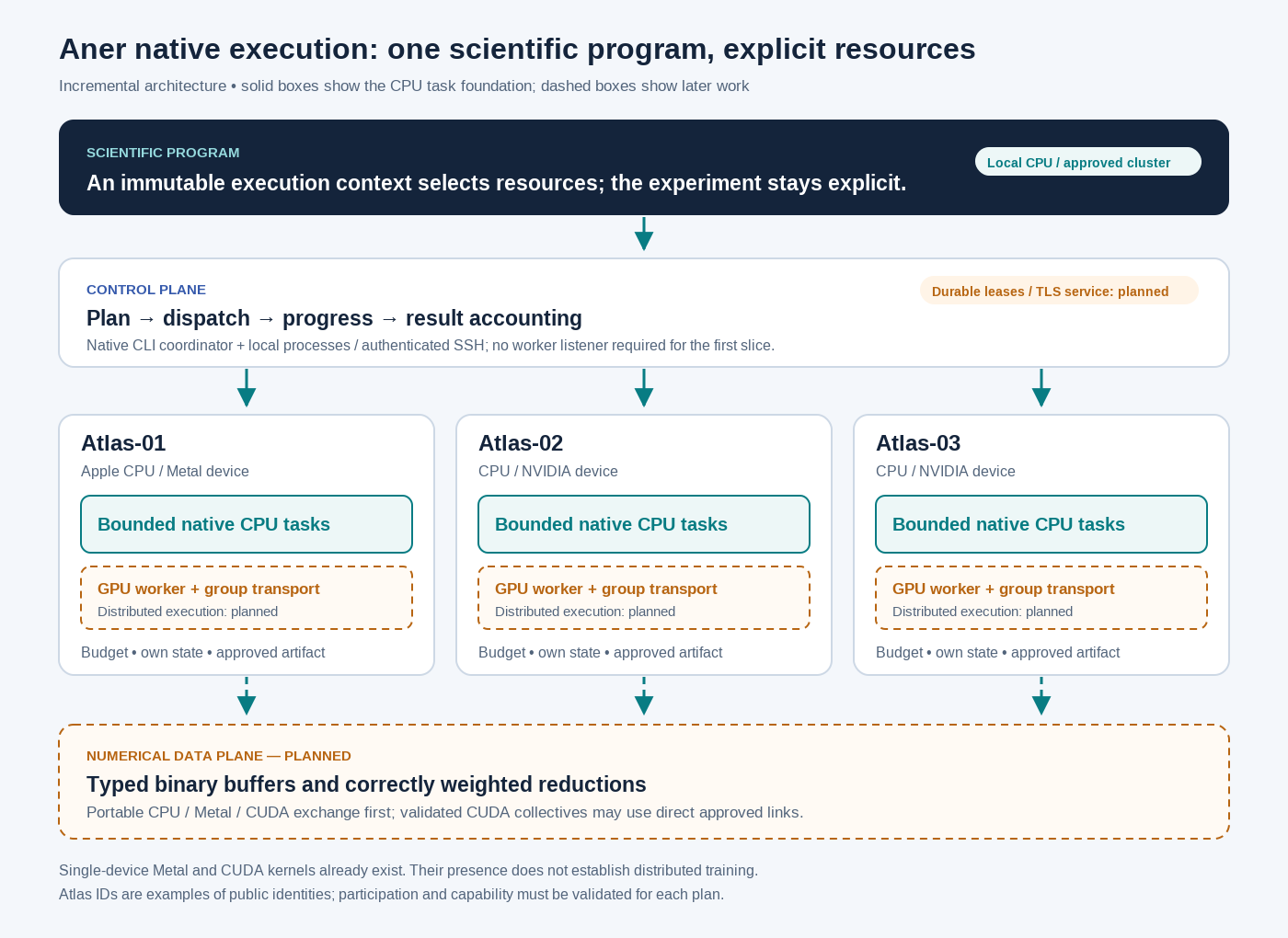
Open the native execution diagram at full size
Terminal jobs and private configuration
The native CLI retains a fixed π estimator as an internal benchmark and protocol fixture. It is not a public aner.parallel source function and does not demonstrate remote repeat callbacks:
aner parallel inventory --json
aner parallel run --samples 10000000 --seed 42 --workers 1 --output simulation-serial
aner parallel run --samples 10000000 --seed 42 --output simulation-parallel
aner parallel status --job simulation-parallel --json
Use a new output directory for every run. The CLI records run-manifest.json, atomically replaced status.json snapshots and a terminal result.json when available. The manifest retains requested work, sample stream identity and local allocation inventory. A completed result must account for the exact requested samples. --quiet suppresses terminal progress; it does not change the simulation or result accounting.
For a configured CPU group used by native source repetitions or the fixed CLI fixtures, prepare a private text file with this implemented schema. The paths and SSH alias below are placeholders to replace with approved installed executables and an enrolled SSH configuration:
ANER_CLUSTER 1
worker "Atlas-01" local "-" "/path/to/aner" 2
worker "Atlas-02" ssh "research-peer" "/path/to/aner" 2
Every record supplies a unique public Atlas identity, local or ssh transport, endpoint, absolute executable path and a positive CPU slot budget for that worker process. Native source repetitions require the full updated aner executable on each platform, built from a compatible patched source revision; the standalone fixed fixture worker is insufficient. A process admitted with two slots creates two local worker threads; its OS schedules them on eligible logical CPUs. Use one worker record per SSH target in this initial schema; multiple local process records must share the local CPU budget. The worker validates its requested slots against its discovered allocation. Aggregate local process slots also respect the submitting machine's allocation. A cluster needs at least one sample chunk per configured worker process so every selected process participates; remaining work is dispatched as processes become ready.
chmod 600 private.cluster
aner parallel run --samples 10000000 --seed 42 --chunk 65536 \
    --cluster private.cluster --output simulation-cluster
aner parallel status --job simulation-cluster --watch
The same private CPU configuration can select checked source tasks:
let results = parallel.repeat(iterations: 1000, task: pick_number,
    parameters: List(), execution: parallel.cluster(config: "private.cluster"), seed: 42)
print(results.summary())
This fragment uses the pick_number declaration above. aner check starts no network activity. At execution, each selected process receives initial work; remaining bounded task batches go to ready processes, allowing different computers to contribute different amounts. Native repetition admits at most 32 processes and 256 aggregate CPU threads, subject to each host allocation. Original global task indices, derived task seeds and ordered result rows do not change with assignment.
The remote codec accepts numeric/Bool/String, explicit FrozenArray inputs and nested List trees. Frozen aliases reuse one immutable registration per backing per worker; shared mutable List aliases, cycles, mutable input arrays/classes remain rejected. Task local arrays are supported; nominal class declarations/methods are not shipped. Legacy scalar/List calls without frozen inputs retain 1 MiB request/response guards. Frozen input or typed output calls use dedicated numerical payloads bounded to 64 MiB and admit at most 64 MiB of unique frozen payload per worker; generated source retains its 1 MiB guard and protocol headers/summaries have separate bounds. Retained declarations and parameter source serialization have additional budgets. Remote session tasks/cells retain a one million step limit and operations a fixed 120 second deadline. Raising the submitter's CLI step budget does not raise that remote guard. Version, source contract fingerprint, random engine and addressed probes are admitted before work; the fingerprint is not proof that all binary/library dependencies match. See the complete cluster repetition reference.
results.summary() distinguishes native-cpu-threads/native-task-calls from native-cpu-cluster/node-requests through its backend and peak scope fields. Cluster nodes report public identity, target, CPU slots, completed task iterations, compute seconds and observed local task peak. These counts refer to function calls, not any inner simulation samples. Global cluster time includes connections, admission, work and worker teardown; node compute times and local call timing have different boundaries. A task/transport failure aborts the group and publishes no partial source result; source repetition has no durable retry, resume or detached job service.
On POSIX, configuration is an owner only regular file; job output is an owner protected directory. SSH uses verified host keys and batch authentication. Keep credentials out of this file, source code and command arguments; configure the authentication through approved SSH credentials. Real endpoints remain private. Public sample output uses Atlas identities.
POSIX systems also support a detached native CPU job with an independent monitor and cancellation:
aner parallel run --samples 100000000 --seed 42 \
    --output simulation-background --background
aner parallel status --job simulation-background --watch
aner parallel cancel --job simulation-background
--background requires a new output directory and detaches the coordinator from the submitting terminal. Its log is coordinator.log. Closing or interrupting a status monitor does not cancel that job; cancellation is the explicit owner authorized command. The job runs only while its coordinator process remains alive. On POSIX, an owner only process lock identifies the active coordinator; worker executables do not inherit that lock. A fresh status monitor reports COORDINATOR_OFFLINE after coordinator loss and retains the last confirmed snapshot. This process lock is distinct from a persisted task lease. Atomic snapshots and detachment do not provide restart recovery, automatic failover, persisted task leases or a distributed checkpoint service. Background orchestration remains unavailable in the initial Windows build. The new development compiled task path has a separate Windows local process backend, protected enrollment rules and a registered native SSH subsystem route for remote Windows hosts; see compiled parallel tasks. Older interpreted/background protocols do not admit subsystem tokens. Its Linux and Windows execution checks are prepared and deferred, and this background job description does not establish their platform validation.
Conditional cluster dependency guidance
Native cluster process startup and transport failures can include a recognized cause hint. Ordinary local execution performs no SSH check; a cluster containing only local records also needs no SSH client/server. SSH guidance appears only for an explicitly selected SSH transport and an observed relevant failure. Aner prints suggested commands; it does not install packages, change services or expose raw captured stderr.
If the submitting host cannot launch its SSH client, macOS guidance points to its normally provided /usr/bin/ssh and PATH; on an Ubuntu host the client package is openssh-client (sudo apt install openssh-client). A refused connection does not prove the server package is absent. For an Ubuntu worker, first check systemctl status ssh; only if the package is absent run sudo apt install openssh-server, and only if its service is stopped run sudo systemctl enable --now ssh. Check the configured port and firewall too.
Authentication failures instead direct users to the SSH user/key, agent and authorized_keys; host key failures require trusted fingerprint verification while retaining strict checking. Reachability/DNS failures direct users to the alias/address, network, port and firewall. These cases do not recommend installing an SSH server. Worker launch or shared library failures direct users to the configured absolute engine path, OS/architecture and complete matching package/library setup.
If the OS loader cannot start the main aner executable, Aner itself cannot emit a diagnostic. An already running coordinator can classify recognized worker startup/loader failures, including a safe library basename when available. Unrecognized or application specific failures retain their original transport/protocol diagnosis without guessing a missing dependency.
Coordination and observation
The CLI dispatcher coordinates tasks and records accepted progress. A later durable service will add persisted leases, bounded retries and checkpoint recovery. This first slice does not resume an interrupted coordinator or claim exactly once arbitrary side effects.
CPU cancellation is cooperative at bounded kernel boundaries: stop submitting work, request active workers to stop and join them. Partial accepted counts are diagnostic information, never a successful full sample count. A task exception propagates to the submitter and pending work is stopped. A process/transport failure must identify the affected worker and fail visibly; it does not silently drop that contribution.
For source calls, Dev and Prod keep the same scientific kernel, seeds, resource checks and accounting. Prod omits optional automatic inspection. Existing development reports can observe ordinary scalar values extracted after a parallel call; detailed cluster task timelines, live GPU telemetry and notebook streaming are future observability work. A screen refresh must not become a training barrier or an automatic GPU readback. Missing utilization, memory or network measurements are N/A, not zero.
Report completed work, elapsed time and observed throughput. The historical CPU only benchmark build reported analytic_training: true and distributed_neural_training: false; those archived fixture results do not establish a neural network capability. Aner 0.0.5 runtime additionally reports supported distributed Dense training through the distributed neural guide. A remaining time estimate, when implemented, requires a fixed horizon and enough completed work. It does not predict how many epochs achieve a research target.
Experimental analytic training fixture
The current CLI also includes a small native binary logistic regression fixture for validating training reductions. It generates eight procedural features plus a bias from stable sample identities, uses fixed synthetic labels, initializes nine Float64 parameters to zero and applies full batch SGD to mean binary cross entropy.
aner parallel regression --samples 65539 --steps 8 --rate 0.25 \
    --seed 42 --workers 1 --quiet --output regression-serial
aner parallel regression --samples 65539 --steps 8 --rate 0.25 \
    --seed 42 --cluster private.cluster --quiet --output regression-cluster
The same fixed samples value is the global batch on every step, not a per worker batch. Workers receive disjoint ranges with frozen parameters and return gradient sums, loss sums and valid counts. The coordinator divides the global sums by the valid count and performs one update. Unequal final chunks remain correctly weighted. Initial and final metrics are separate complete passes.
This fixture exercises native CPU training semantics; it is not a neural network, a general regression fit API or a held out evaluation. Its fit_accuracy measures agreement on the same synthetic rows used for updates and does not establish generalization. This CPU analytic fixture remains separate from the supported Dense Dataset training API, which includes fitted preprocessing and protected mini batches. Arbitrary custom objectives and durable distributed job checkpoints remain later work. Source level contexts support checked local repetitions and the separate explicit Dense fit; this analytic fixture is exposed through the experimental CLI.
For e updates, n rows, f features and k row chunks, total work is O((e + 2)nf), including initial/final metric passes. Chunk gradient state is O(kf), with O(f) canonical parameters and bounded worker/transport bookkeeping. This fixture fixes f = 8. Local reductions currently use 65,536 row chunks; configured worker reduction chunks can be selected explicitly subject to admission limits. Floating reduction order can differ between a local and a differently chunked distributed plan; validate declared tolerances rather than promise cross plan bitwise equality.
Three distinct forms of cooperation
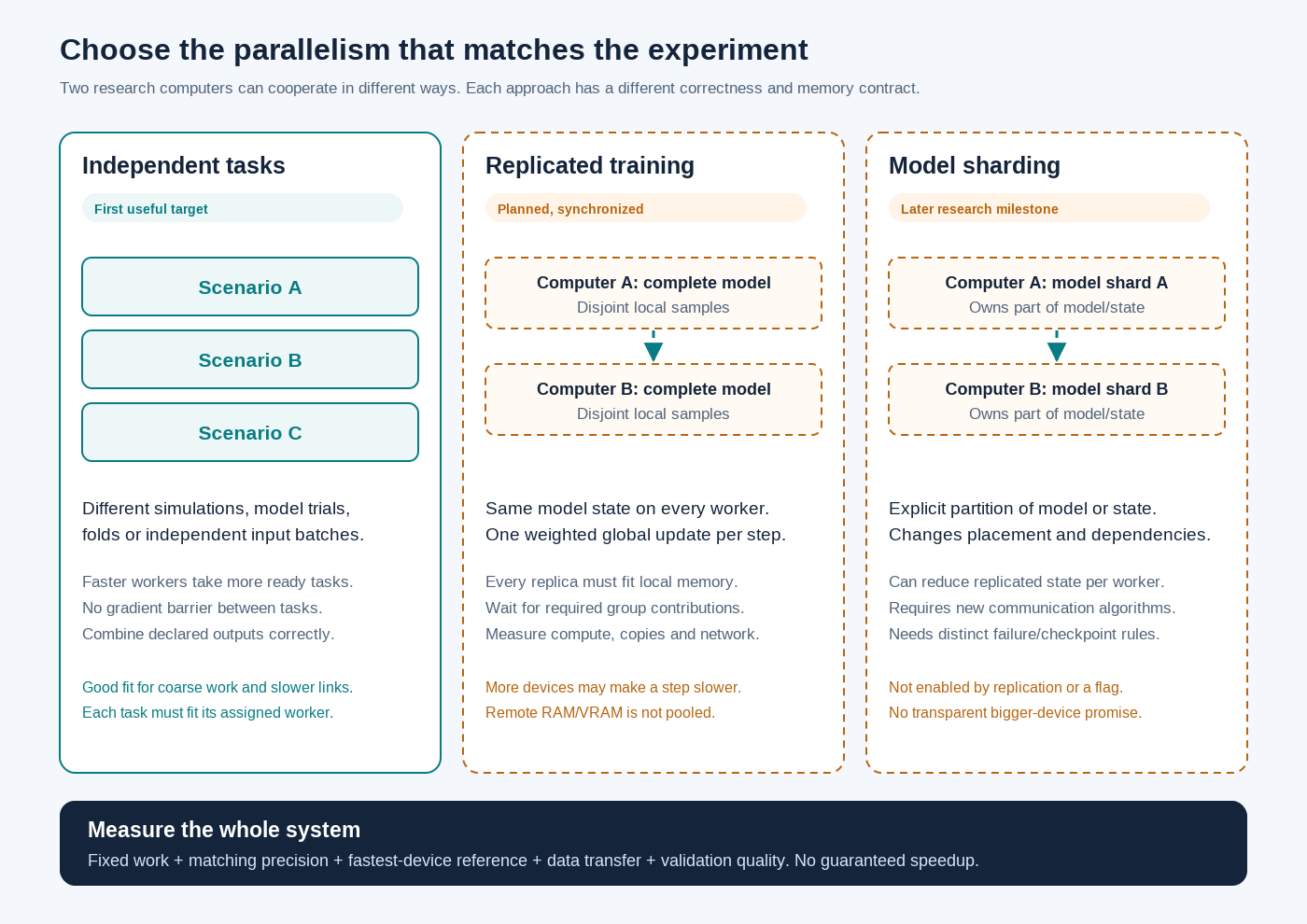
Open the parallel strategies diagram at full size
Independent simulations, model search trials and separate folds can run without a gradient barrier between tasks. Their outputs still require an appropriate aggregation rule. Cross validation folds are independent fits; they are not partitions of one global optimizer update. Shared groups and held out roles remain governed by Dataset partitions.
Synchronous replicated Dense training is a different supported computation. Every device retains a complete model and processes a disjoint part of one fixed global batch. The group combines gradients and advances the optimizer once. Each replica must fit its parameters, gradients, local activations and workspaces. The Dense extension keeps optimizer state on its canonical CPU coordinator. Two computers do not become one device with the sum of their memory.
Model or optimizer state sharding can distribute persistent state. It needs distinct ownership, communication, checkpoint and failure algorithms. It is not activated by launching two replicas or changing an execution context.
Neural training contract
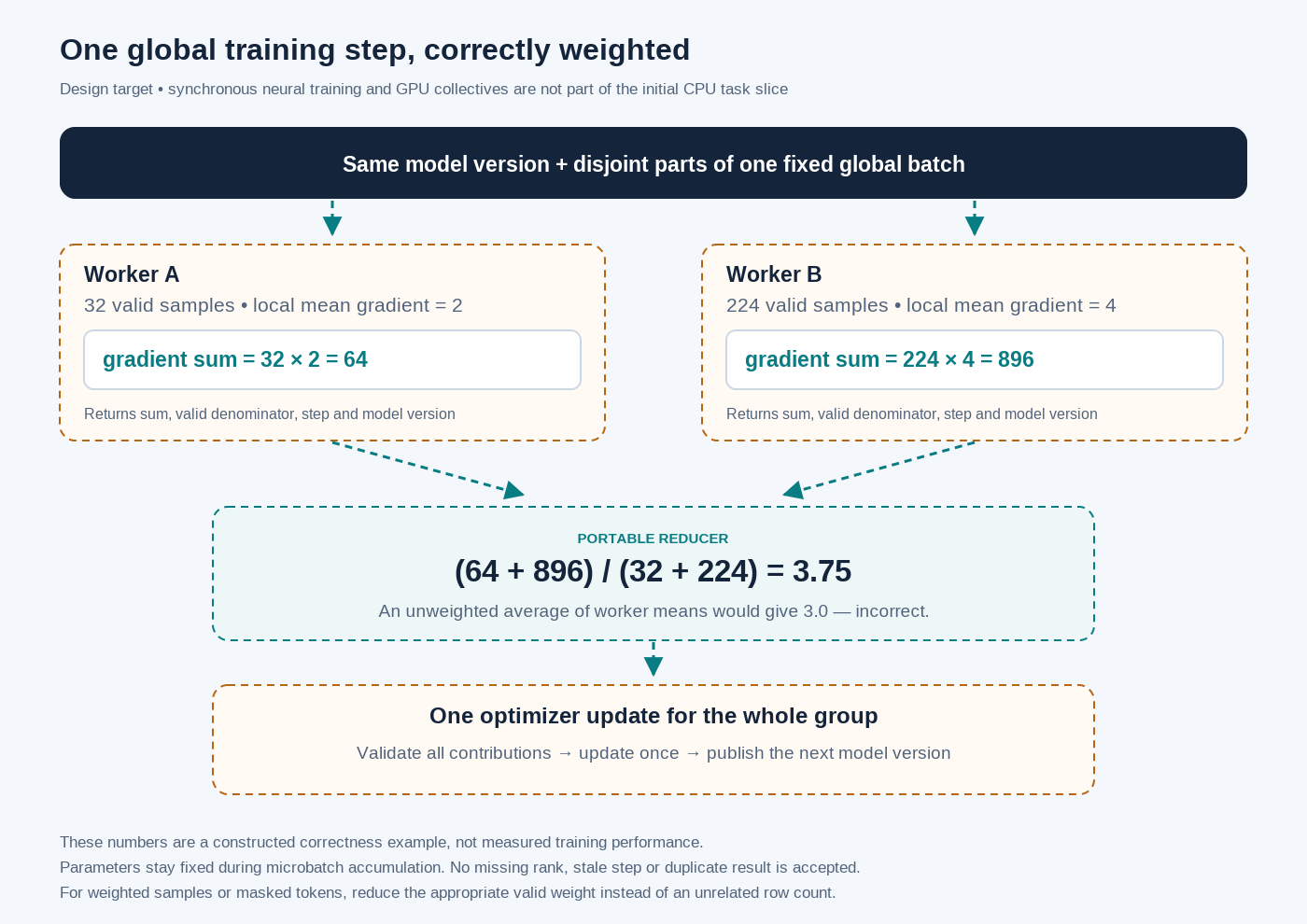
Open the weighted training diagram at full size
The supported Dense training group preserves the experiment: source identity, training/validation/test roles, exact sample assignments, model initialization, optimizer, loss, requested precision, global batch and stopping rule. Normalization is fitted on training rows before held out evaluation; distributed placement must not bypass these checks. Training batches are disjoint, the final partial batch is retained, and retry results cannot be counted twice.
When worker i contributes a mean gradient gᵢ from nᵢ valid samples, the global mean is:
global_gradient = sum(nᵢ × gᵢ) / sum(nᵢ)The native Dense runtime exchanges gradient sums and valid denominators directly. Means 2 and 4 over 32 and 224 samples combine to 3.75. An unweighted worker average of 3.0 changes the algorithm. Weighted samples or masked tokens require their appropriate valid weight denominator.
All replicas start from the same model version, hold parameters fixed during local microbatch accumulation and perform one shared update. They follow the same collective order even with unequal sample counts. A lost rank aborts the affected group; a partial gradient does not become a normal update. Durable distributed restart from a committed group checkpoint remains unimplemented.
The portable Dense reducer synchronizes local device completion, exchanges typed host buffers, applies one canonical CPU update and distributes the new state. It supports mixed CPU, Metal and CUDA replicas with explicit transfer costs and one compatible group dtype. See distributed neural training for actual signatures, precision and Dataset boundaries. A later optimized homogeneous CUDA collective can exchange gradients directly over compatible approved links. The coordinator continues to manage membership and progress without necessarily relaying all gradient bytes. NVIDIA's collective communication overview describes the native primitives; Aner's adapter requires separate implementation and hardware validation.
Precision and two cooperating Macs
The existing preserve policy retains Float64 on CPU or supported CUDA operations. Metal/MPS currently uses Float32; preserving Float64 reports CPU execution. A strict Dense cluster declares one supported compute precision for every participant, with Float64 host accumulation/canonical updates. MPS Float64 is rejected by explicit replica contexts; the separate local profile can still report preserve policy CPU fallback. Precision conversion and actual placement remain visible. See Tensor devices.
Two Apple computers can be useful for independent research tasks and may improve a sufficiently large replicated training workload on an adequate link. Useful compute must exceed scheduling, host buffer copies, network exchange and synchronization costs. A smaller model or a slow link can make the combined training run slower than the fastest computer alone. Apple's Metal framework enables native local GPU work; separate Macs still have separate memory and device queues.
A larger model whose replicated state does not fit either Mac still does not fit under ordinary data parallelism. Smaller microbatches reduce activation memory, but not the need to retain replicated model and optimizer state. Model sharding is the later route to that different capacity problem.
Time and space complexity
For generic repeat, n invocations with task work W and output width d require O(nW) useful work, O(nd) retained result space and bounded queue/worker bookkeeping. Parameter snapshots, per invocation copies, scheduling and statistics add costs described in the repetition reference. There is no guaranteed n/p elapsed time.
For the retained internal CLI π fixture, let n be samples, c chunk size, k = ceil(n/c), p worker threads and q the bounded queue capacity. Each sample has constant native work and the sufficient statistics are integer counts.
| Operation | Time | Additional space |
|---|---|---|
| Generate and count all Monte Carlo samples | O(n) total computation | O(1) per active chunk |
| Dispatch k chunks and aggregate their statistics | O(k) scheduling and reduction | O(k) chunk statistics plus O(q + p) executor bookkeeping |
| Local ideal compute span | O(ceil(k/p)c), bounded above by uniform chunk work | Same O(k + q + p) runtime storage |
| Configured process/network dispatch | O(n) computation plus O(k) protocol work | Bounded records and in flight work; no n point coordinate array |
| Result estimate from accepted counts | O(1) | O(1) |
The ideal span assumes p workers can make progress simultaneously. It excludes thread/process startup, OS scheduling and CPU contention, serialized dispatch, heterogeneous workers and transport. It is a theoretical ideal rather than measured wall clock complexity. The scientific computation stores chunk statistics, not an n row point dataset. A future map returning every transformed element would necessarily retain O(n) output or stream it through another explicit contract.
The initial CPU milestone plan used the following generic replicated storage model; the current Dense path instead keeps typed optimizer state on its canonical CPU coordinator, as detailed in the distributed neural guide. For that historical plan with P parameter scalars, dtype width d and p workers, persistent model/gradient/optimizer storage is O(Pd) per worker and O(pPd) across replicas, plus batch dependent activations and workspaces. A central streaming reduction performs O(pP) arithmetic and receives O(pPd) gradient bytes per step; it can use O(Pd) accumulator space plus bounded buffers. Retaining every worker payload instead uses O(pPd). Redistribution also transfers O(pPd) aggregate parameter bytes. The actual collective bound depends on its algorithm and topology.
Transferring G bytes at measured effective bandwidth b takes at least G/b seconds, before latency and other work. A synchronous step waits for its required contributions. More devices do not remove serial dependencies, memory bandwidth limits or barriers.
Evaluate scaling honestly
Measure a one worker reference, each machine alone, the fastest eligible machine alone and the combined plan. Fix sample count, seed and algorithm for simulations; additionally fix global batch, model, precision and optimizer for training. Report at least three repetitions, median and spread, warm up, cold staging versus cached execution, end to end duration and compute/transfer/wait costs. Preserve unfavorable results.
For comparable homogeneous resources, speedup(p) = T(1)/T(p) and efficiency(p) = speedup(p)/p. Worker counts and admitted CPU slot budgets alone do not measure useful concurrency or CPU utilization. Heterogeneous throughput predictions remain estimates until the selected combination is measured. Report validation quality and time to a fixed quality target for training, not only steps per second.
Public reports use a stable platform alias and immutable measured configuration, such as Atlas-02 / C01. A RAM, CPU/GPU, driver or engine build change retains the Atlas ID and creates a new configuration revision. A different computer receives a different ID, including two computers with the same processor generation. Private hostnames, routes and credentials are excluded from public assets.
No multi GPU, mixed device neural training or cross network speedup is implied by the CPU simulation. Each such combination requires its own capability, numerical, failure and measured performance acceptance evidence.
Measured native CPU validation
This section is historical evidence from the frozen native CLI fixture, not measurements of the current source level Philox π example. Trial JSON, timings and recorded source/build hashes remain unchanged.
The October 12, 2026 experiment executed the compiled native CPU implementation on one Apple computer and three Ubuntu VMs. It contains 22 cases with three measured repetitions each: 66 recorded trials, plus one excluded warm up per case. Every trial completed the requested scientific work. The report includes unsuccessful scaling configurations; it does not establish GPU or general distributed neural training performance.
| Platform configuration | Visible CPU allocation | Guest visible or installed memory | Tested compute budget |
|---|---|---|---|
Atlas-01 / C02 | Apple M2 Max; 12 logical CPUs | 64 GiB installed | 1, 2, 4, 8 or 12 local workers for simulation; 1, 4 or 12 for the analytic fixture |
Atlas-02 / C02 | Ubuntu 26.04.1; x86_64; 2 vCPUs | 15.05 GiB guest visible | 1 CPU slot |
Atlas-03 / C02 | Ubuntu 26.04.1; x86_64; 24 vCPUs | 60.47 GiB guest visible | 1 CPU slot |
Atlas-06 / C01 | Ubuntu 26.04.1; x86_64; 6 vCPUs | 9.14 GiB guest visible | 1 CPU slot |
A visible allocation is not a measurement of dedicated physical capacity. VM host sharing, competing workload and physical topology were not established. The remote experiments intentionally configure one CPU admission slot per worker process, including Atlas-06; they do not compare maximum all core VM performance. The coordinator runs on Atlas-01 and contributes coordination rather than an additional simulation or gradient worker in the remote groups. Its CPU and network overhead remain in the wall time. No GPU is used in these experiments.
Scientific and timing contract
The simulation requests exactly 1,000,000,000 samples with seed 42, Float64 coordinate arithmetic and integer hit/count statistics. Every local and remote repetition produced exactly 785,380,324 hits and the estimate 3.141521296. Local and individual remote commands use 1,000,000 outer samples per chunk. Cluster cases compare that chunk with 100,000,000; the native worker subdivides its assigned range into bounded internal chunks. Coarsening changes scheduling, not sample identity or the estimator.
The analytic fixture uses the same 262,147 generated rows as one fixed global batch on each of 16 SGD updates, rate 0.25 and seed 42. Eight features plus a bias give nine initially zero Float64 parameters. Initial and final full batch metric passes bring the total to 18 passes. Final loss is approximately 0.5320923849 and fit accuracy is 0.9663852724. All parameter and loss differences were within absolute tolerance 1e 10; fit accuracy differences were within 1e 12. This is fitting set agreement on a synthetic fixture, not held out accuracy or a neural benchmark.
The primary duration is an external monotonic clock around a fresh native command, including process startup, authenticated transport when used, native work and shutdown. An individual remote reference includes one SSH invocation and the native command. A distributed case includes the coordinator command and persistent worker connections. Native internal durations are retained in the downloads but have different boundaries: a local call excludes prior execution context construction, while distributed execution includes worker setup. Those internal durations are not interchangeable end to end measurements. Data staging and compilation precede timing; no compilation or test suite ran concurrently with the timed cases.
The tables give median and observed minimum: maximum seconds over three repetitions. This spread is descriptive, not a confidence interval. Memory peaks, CPU utilization, transfer bytes, per step barrier wait and effective network bandwidth were not instrumented for this experiment and are N/A. Guest memory capacity is not process memory use. A separate protected stream small line echo probe on one participating connection measured approximately 55 to 61 ms round trips after connection establishment; it is diagnostic evidence, not a bandwidth measurement or an estimate for every link.
All selected native workers recorded the same source contract fingerprint for this experiment:
794e80a8d69285e18f7bec4d5f06cf2a8fa85f9e4d1c9202dac661861d972beaThe Apple executable and Linux executable are different architecture specific artifacts. The Linux worker was compiled with GCC 15.2, C++20, -O3, -DNDEBUG, -fno-fast-math, -ffp-contract=off and native thread support; it has no GPU dependency. Compatible source identity was validated at the worker handshake. The standalone native worker contains the supported task and analytic fixture CLI; source programs were separately checked with the full native development runtime. Earlier calibration builds are excluded from this report.
Local simulation scaling
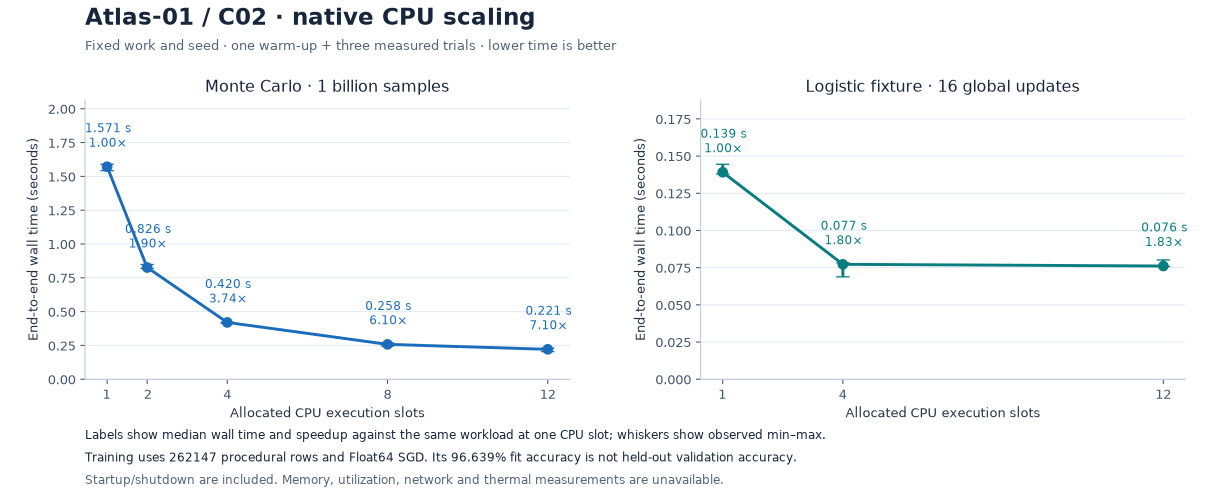
Open the local scaling chart · Download the local chart as PNG
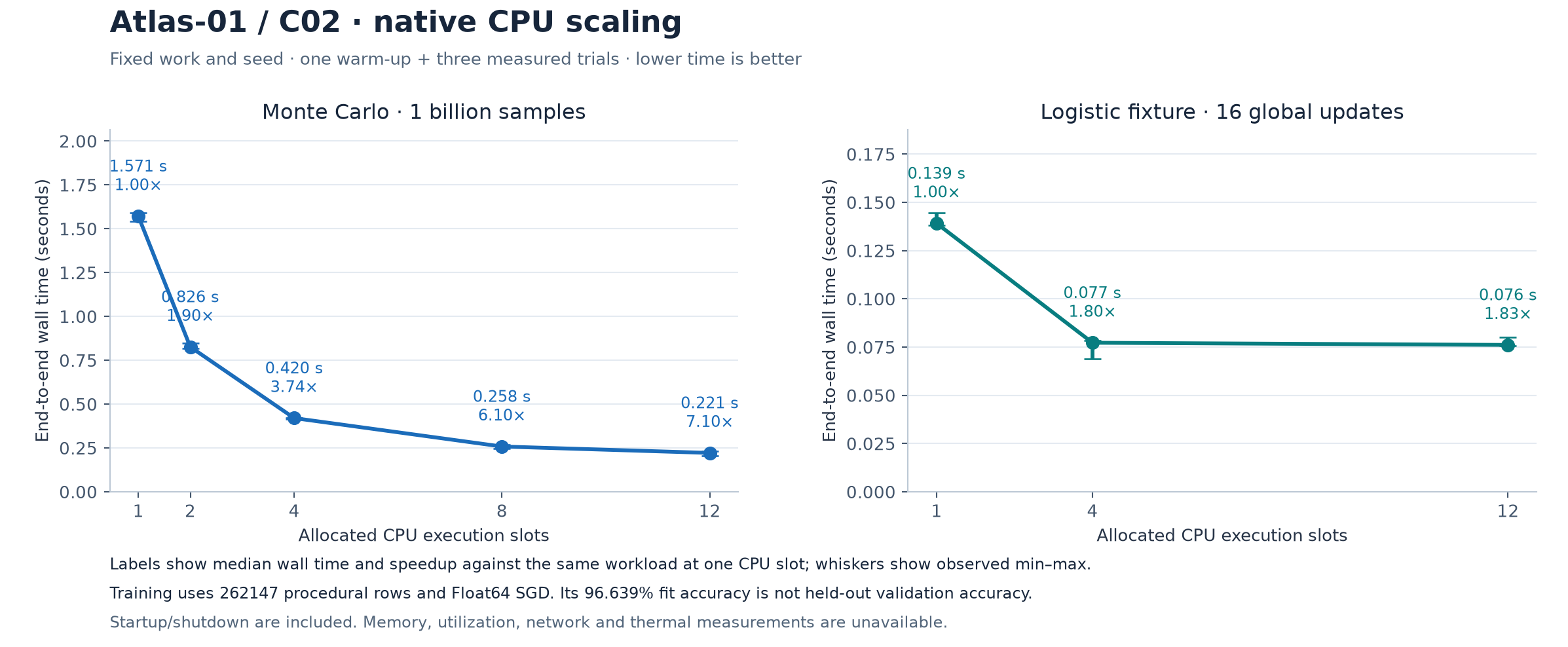
Atlas-01 / C02 executes the identical one billion sample workload. The local tables report configured worker threads; CPU placement and utilization were not instrumented:
| Local workers | Median seconds | Minimum: maximum seconds |
|---|---|---|
| 1 worker | 1.5715 | 1.5429 to 1.5894 |
| 2 workers | 0.8260 | 0.8191 to 0.8486 |
| 4 workers | 0.4198 | 0.4128 to 0.4218 |
| 8 workers | 0.2578 | 0.2450 to 0.2686 |
| 12 workers | 0.2212 | 0.2043 to 0.2302 |
The measured 12 worker speedup is 7.10×, with efficiency approximately 0.59. This is evidence for this native kernel and machine configuration, not a guarantee for arbitrary source loops, heterogeneous cores or neural training.
The local analytic fixture is much shorter:
| Local workers | Median seconds | Minimum: maximum seconds |
|---|---|---|
| 1 worker | 0.1391 | 0.1380 to 0.1445 |
| 4 workers | 0.0772 | 0.0688 to 0.0782 |
| 12 workers | 0.0761 | 0.0758 to 0.0802 |
Its 65,536 row reduction plan contains only five chunks per pass. Twelve configured worker threads therefore cannot execute twelve independent gradient chunks at once, and process startup is material relative to the short native computation.
Networked CPU execution
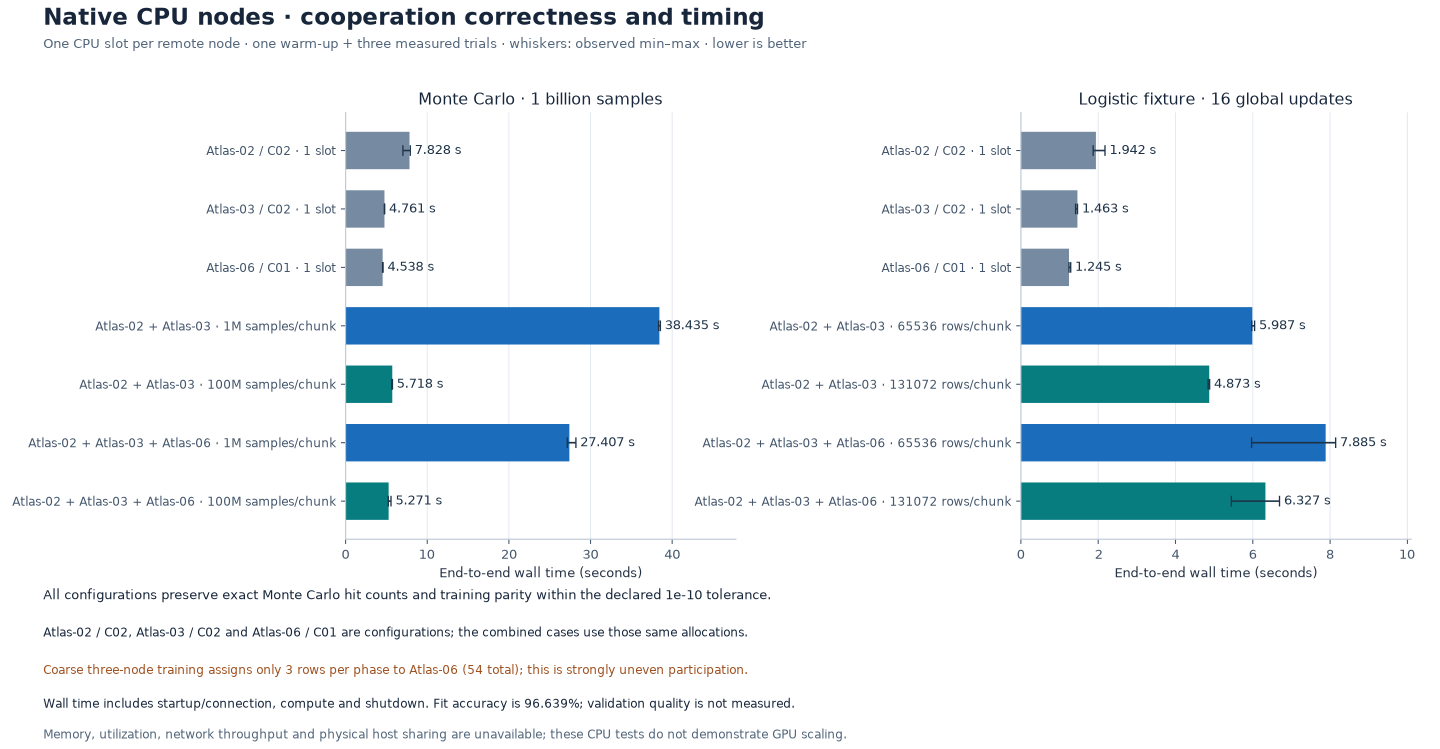
Open the cluster timing chart · Download the cluster chart as PNG
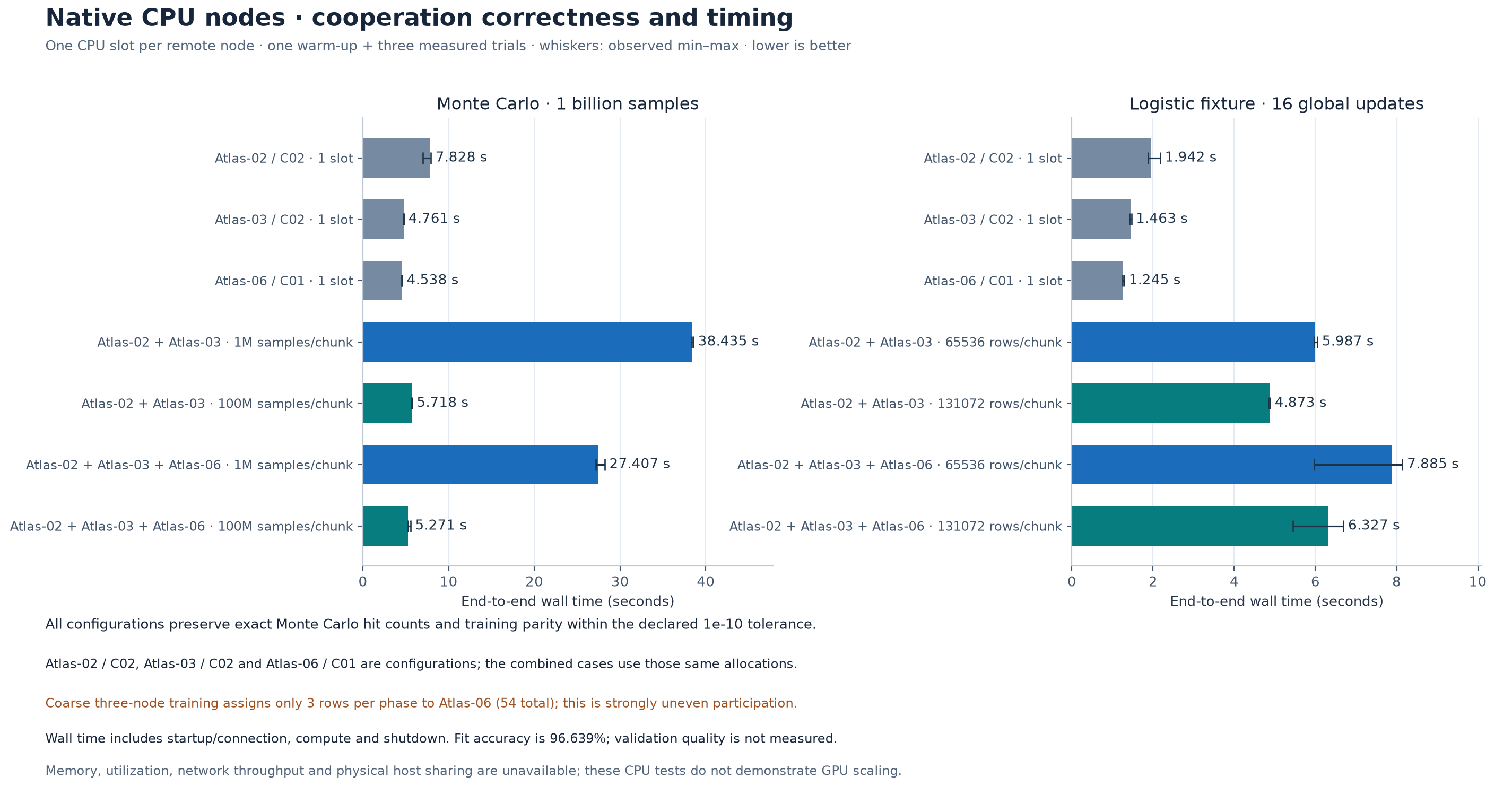
Simulation, fixed at one billion samples and one CPU slot per selected VM:
| Execution plan | Median seconds | Minimum: maximum seconds |
|---|---|---|
Atlas-02 alone; 1 slot | 7.8280 | 7.0210 to 7.9237 |
Atlas-03 alone; 1 slot | 4.7607 | 4.7576 to 4.7741 |
Atlas-06 alone; 1 slot | 4.5376 | 4.5347 to 4.5788 |
Atlas-02 + Atlas-03; 1,000,000 samples/chunk | 38.4350 | 38.3402 to 38.5559 |
Atlas-02 + Atlas-03; 100,000,000 samples/chunk | 5.7178 | 5.6449 to 5.7374 |
Atlas-02 + Atlas-03 + Atlas-06; 1,000,000 samples/chunk | 27.4075 | 27.1461 to 28.2094 |
Atlas-02 + Atlas-03 + Atlas-06; 100,000,000 samples/chunk | 5.2713 | 5.2303 to 5.5606 |
Increasing the pair's outer chunk from one million to 100 million samples reduces median time by approximately 6.72×. The three worker coarse plan takes 5.2713 seconds, compared with 4.5376 seconds for the fastest eligible individual VM. It is still slower. Counts verify cooperation and correctness; elapsed time shows that coordination and scheduling costs outweigh added compute for these configurations.
Analytic full batch fixture, with one CPU slot per selected VM:
| Execution plan | Median seconds | Minimum: maximum seconds |
|---|---|---|
Atlas-02 alone; 1 slot | 1.9417 | 1.8703 to 2.1762 |
Atlas-03 alone; 1 slot | 1.4631 | 1.4147 to 1.4653 |
Atlas-06 alone; 1 slot | 1.2450 | 1.2448 to 1.2891 |
Atlas-02 + Atlas-03; 65,536 rows/chunk | 5.9872 | 5.9729 to 6.0469 |
Atlas-02 + Atlas-03; 131,072 rows/chunk | 4.8733 | 4.8436 to 4.8836 |
Atlas-02 + Atlas-03 + Atlas-06; 65,536 rows/chunk | 7.8849 | 5.9687 to 8.1435 |
Atlas-02 + Atlas-03 + Atlas-06; 131,072 rows/chunk | 6.3267 | 5.4455 to 6.6910 |
Every selected worker contributed accepted samples in every phase. The coarse three worker plan has only three chunks: 131,072, 131,072 and 3 rows. Atlas-06 receives the three row chunk in each of the 18 passes, totaling 54 rows, while each other worker processes 2,359,296 rows. This deliberately retained case validates unequal count weighting; it is very uneven participation and does not demonstrate three worker training capacity scaling. The dispatcher does not yet optimize chunk size from measured device or network cost.
The measured results support coarse independent tasks as the first remote strategy. A future planner should measure startup, task and link cost, then recommend a local or distributed plan while preserving an explicit forced plan experiment. The current parallel.local and parallel.cluster policies are explicit; they do not automatically predict the fastest plan. General Tensor gradient exchange and GPU collectives require their own implementation, correctness tests and measurements.
Reproducibility artifacts and validation status
Download the complete 66 native trial records and 22 case summary. Public artifacts retain Atlas identities, immutable configuration revisions, scientific parameters, per worker accepted work, source fingerprint and timing. Operator routing and credentials remain private.
The development and release builds passed the existing native suite with the new parallel tests. Focused tests cover bounded admission, exact count parity, cancellation, exceptions, child process cleanup, source/protocol mismatch, task identity and sample accounting rejection, stable weighted gradients, uncommitted step cancellation, detached coordinator readiness and monitoring after coordinator loss. Local native executor, process, training and distributed tests also underwent race and memory safety instrumentation. Linux checks ran on Atlas-02 and Atlas-03; the three worker process cases ran on Atlas-03 because Atlas-02 exposes only two CPU slots. Atlas-06 ran only the approved one slot scientific worker. Its temporary test executable was removed after the experiment.
GPU tasks, multiple GPUs, mixed Metal/CUDA neural training, general Dataset based distributed training, durable checkpoint recovery and cross network enrollment are NOT_RUN for this slice. Their design remains staged work, rather than a benchmark conclusion.
See the complete callable index for the native module and method name catalogue.
Continue with Decimal tasks across machines for this specialist contract.
Continue with Typed output and resident pipelines for this specialist contract.